

From SwRI Southwest Research Institute is leading two groundbreaking experiments — on the ground and in the air — to collect astronomical data from the total solar eclipse that will shadow a large swath of the United States on April 8, 2024. SwRI’s Dr. Amir Caspi leads the Citizen Continental-America Telescopic Eclipse (CATE) 2024 experiment,…
SpaceX returns vital life science research sponsored by the ISS National Lab
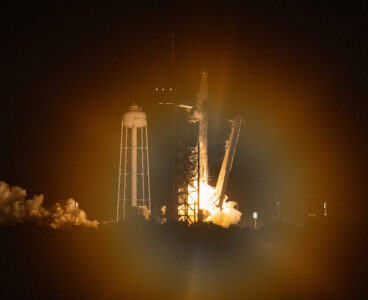
Dozens of science and technology development payloads returned to Earth from the International Space Station (ISS) on December 22 as SpaceX’s 29th Commercial Resupply Services (CRS) mission, contracted by NASA, successfully concluded. More than 30 payloads sponsored by the ISS National Laboratory returned on this mission, many of which were life science investigations aimed at…
SwRI’s Dr. Alan Stern conducts space research aboard Virgin Galactic’s VSS Unity
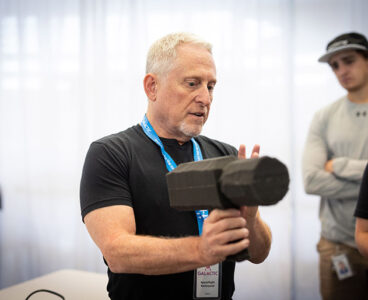
Dr. Alan Stern, a planetary scientist and associate vice president of Southwest Research Institute’s Space Sector, flew on Nov. 2 aboard the Virgin Galactic commercial spaceship Unity on a suborbital space mission. During the roughly 60-minute mission, first mated to its carrier aircraft VMS Eve, then horizontally launched into space, Stern tested equipment and trained…
Northern Germany’s expanding R&D ecosystem focuses on space

Flight history in Bremen, Germany, began more than a hundred years ago. Since then, this important northern German city has become well known as the second-largest aerospace hub in the country. Over the past several years, Bremen has established itself as a standard-bearer in aerospace R&D. A growing network of Bremen-based organizations now play leading…
Investigation onboard the Space Station seeks new insights into cooling technology for electronics
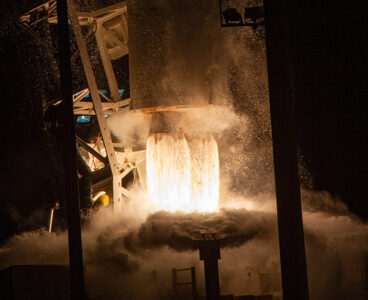
What if microgravity holds the key to preventing the overheating of advanced electronics? That’s one idea behind an International Space Station (ISS) National Laboratory-sponsored investigation that recently launched to station on Northrop Grumman’s 19th Commercial Resupply Services mission (NG-19). The experiment aims to improve the efficiency of heat transfer devices used in various technologies, from…
Keck Planet Finder, in search of exoplanets
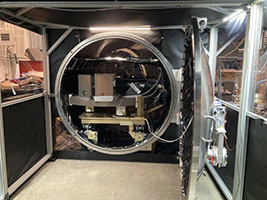
by Jim McMahon Astronomers have confirmed more than 5,000 exoplanets orbiting distant stars. There are a few aspects that are needed to characterize an exoplanet. One is the size of the planet, and the other is the mass of the planet. Space-based missions, such as the Transiting Exoplanet Survey Satellite (TESS) launched in 2018, find…
SwRI creates Space Sector with two new divisions to support space R&D

From Southwest Research Institute Southwest Research Institute’s Space Science and Engineering Division, with 465 employees in three states, has been restructured to create two new technical divisions. Dr. James L. Burch, vice president of the Space Science Division, will become Senior Vice President leading SwRI’s new Space Sector organization, encompassing all three divisions. Dr. Robin…
R&D 100 winner of the day: Terra Spotlight: A New Paradigm in Rapid Change Detection Using Satellite Images
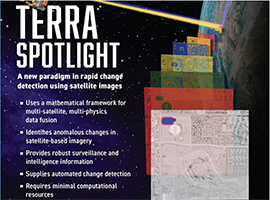
Los Alamos National Laboratory (LANL) has a rich history of designing and deploying space systems. Over 30% of all U.S. space systems have the Laboratory’s fingerprint on them. Terra Spotlight ensures that the Laboratory’s history of scientific excellence in space will continue. Terra Spotlight opens exciting frontiers in remote sensing and our understanding of changes…
Powering the moon: Sandia researchers design microgrid for future lunar base
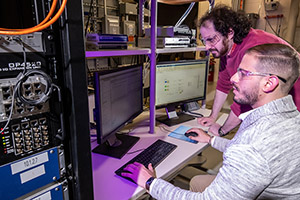
From Sandia National Laboratory Sandia National Laboratories is well-known for designing reliable and resilient microgrids for military bases and vital city services. Now, Sandia researchers are working with NASA to design one for the moon. This is not the first time Sandia has partnered with NASA to power equipment on the moon. In fact, Sandia…
R&D collaborations looking to build expertise, in this week’s R&D power index

The R&D World Index (RDWI) for the week ending February 18, 2022, closed at 5,075.11 for the 25 companies in the RDWI. The Index was down -2.18% (or 113.00 basis points) from the week ending February 11, 2022. The stock of nine RDWI members gained value from 0.96% (Novartis) to 6.14% (Cisco). The stock of…
R&D 100 winner of the day: Traffic Flow Impact (TFI) Tool
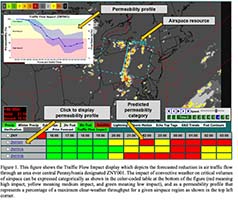
The Traffic Flow Impact (TFI) Tool, from MIT Lincoln Laboratory and the Federal Aviation Administration, is a unique tool that provides air traffic control managers with a display of airspace capacity predictions and potentially achievable and sustainable traffic flow rates by using a revolutionary approach to integrate multiple weather forecasts. TFI uses a novel machine-learning…
Greater than expected growth in fourth quarter, in this week’s R&D power index
The R&D World Index (RDWI) for the week ending January 28, 2022, closed at 5,280.68 for the 25 companies in the RDWI. The Index was up 1.39% (or 72.41 basis points) from the week ending January 21, 2022. The stock of 12 RDWI members gained value from 0.34% (AstraZeneca) to 4.88% (Apple Computer). The stock…
Giant exoplanet discovered close to Earth

From UC Riverside: A UC Riverside astronomer and a group of eagle-eyed citizen scientists have discovered a giant gas planet hidden from view by typical stargazing tools. The planet, TOI-2180 b, has the same diameter as Jupiter, but is nearly three times more massive. Researchers also believe it contains 105 times the mass of Earth…
UC Riverside astrophysicist on Webb: Will it save future Earth?

By Jules Bernstein The James Webb Space Telescope, the most complex and expensive space laboratory ever created, is less than two weeks away from its ultimate destination a million miles from Earth. Once it arrives, it will send information about parts of space and time never seen before. It will also send previously unattainable information…
EVs becoming more collaborative, in this week’s R&D power Index
The R&D World Index (RDWI) for the week ending December 31, 2021, closed at 5,629.50 for the 25 companies in the RDWI. The Index was down -0.39% (or -22.32 basis points) from the week ending December 24, 2021. The stock of 21 RDWI members gained value from 0.11% (Alibaba) to 3.02% (General Motors). The stock…
NASA selects SwRI-led CubeSat to assess the origins of hot plasma in the Sun’s corona
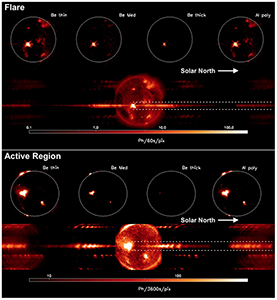
From Southwest Research Institute NASA has selected the CubeSat Imaging X-Ray Solar Spectrometer (CubIXSS), led by Southwest Research Institute, to measure the elemental composition of hot, multimillion-degree plasmas in the Sun’s corona – its outermost atmosphere. The nanosatellite is expected to be launched in 2024 as a secondary payload on another satellite launch. CubIXSS will…
Machine learning tests abilities of rare-earth phosphates given atmospheric extremes

Materials and mechanical scientists are using machine learning to rapidly vet combinations of elements that could be used in next-generation environmental barrier coatings needed to protect vehicles traveling in the extreme conditions of aerospace and space environments. The project, led by researchers at Rensselaer Polytechnic Institute, is supported by the National Science Foundation. Environmental barrier…
New telescope will see planetary neighbors’ atmospheres
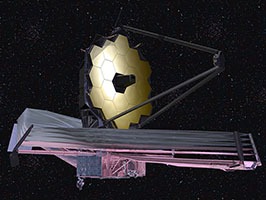
When the world’s most powerful telescope launches into space this year, scientists will learn whether Earth-sized planets in our ‘solar neighborhood’ have a key prerequisite for life — an atmosphere. These planets orbit an M-dwarf, the smallest and most common type of star in the galaxy. Scientists do not currently know how common it is…
SwRI tests liquid acquisition device aboard Blue Origin’s New Shepard rocket
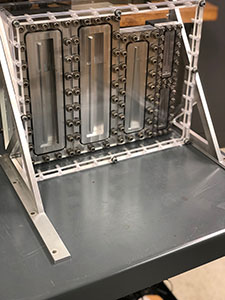
A Southwest Research Institute (SwRI) experiment was performed aboard Blue Origin’s New Shepard suborbital rocket today, which launched from Van Horn, Texas. Five variations of the tapered liquid acquisition device (LAD), which is designed to safely deliver liquid propellant to a rocket engine from fuel tanks, were aboard the rocket to evaluate their performance in…
New Purdue research building will offer a world’s first in hypersonic testing, materials development
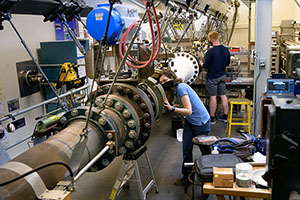
By Brian Huchel, Purdue University Imagine an aircraft flying 2,800 miles across the United States in only 15 minutes. A state-of the-art building ready for construction at Purdue University will provide the facilities to explore that idea through advanced hypersonic research. The planned 65,000-ft2 Hypersonic Applied Research Facility (HARF) will house two cutting-edge wind tunnels,…
Should planes be more like birds?
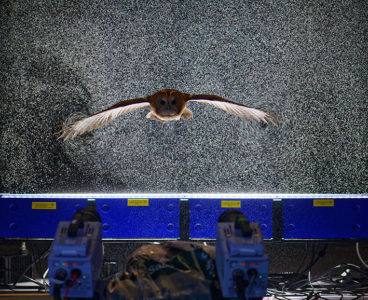
by University of Bristol Would planes be better if they were more like birds? Engineers from the University of Bristol and the Royal Veterinary College have been studying our feathered friends to answer this very question, the answer to which will be revealed at the Royal Society Summer Science 2021. The team from the University’s…
LLNL-Tyvak space imaging payload has taken more than 4,500 pictures of Earth and space
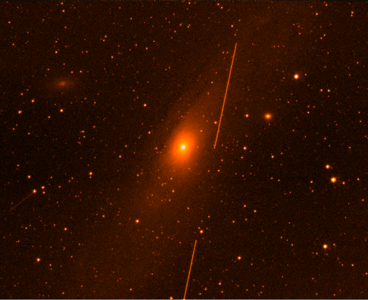
Thousands of images of Earth and space have been taken by a compact space imaging payload developed by Lawrence Livermore National Laboratory (LLNL) researchers and its collaborator Tyvak Nano-Satellite Systems. Known as GEOStare2, the payload has two space telescopes that together have taken more than 4,500 pictures for space domain awareness, astronomy and Earth observations…
Engineers are building a fridge that works in zero gravity – and upside down
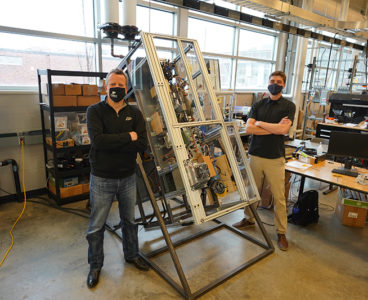
By Kayla Wiles For astronauts to go on long missions to the moon or Mars, they need a refrigerator. But today’s fridges aren’t designed to work in zero gravity – or upside down if oriented that way when a spacecraft lands on another planet. A team of engineers from Purdue University, Air Squared, and…
Control system helps several drones team up to deliver heavy packages
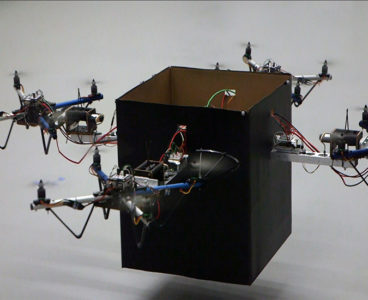
By John Toon, Georgia Institute of Technology Many parcel delivery drones of the future are expected to handle packages weighing five pounds or less, a restriction that would allow small, standardized UAVs to handle a large percentage of the deliveries now done by ground vehicles. But will that relegate heavier packages to slower delivery by…
R&D 100 winner of the day: Multi-burn Solid Rocket: Revolutionizing heritage technology to solve emerging space problems
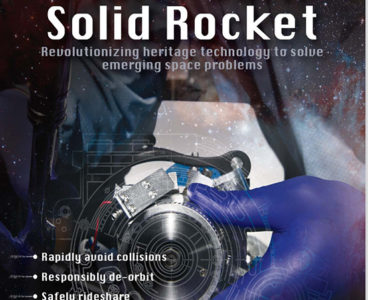
For low-cost small satellites to tackle emerging commercial, scientific and national security missions they need to be capable of maneuvering while still being compatible with rideshare. To responsibly manage our ever more crowded orbit zones into the future, all satellites will soon be required to de-orbit at end-of-life and avoid collisions with space debris at…