

In this, the tenth episode of the R&D 100 Podcast, we examine the latest technology in superconducting magnets. These magnets have existed since the 1960s, but the field available has been limited by the properties of superconducting materials. So, VP, Editorial Director Paul J. Heney and Senior Editor Aimee Kalnoskas of R&D World spoke with…
Purdue thermal imaging innovation allows AI to see through pitch darkness like broad daylight

From Purdue University: The patent-pending innovation sees texture and depth and perceives physical attributes of people and environments Researchers at Purdue University are advancing the world of robotics and autonomy with their patent-pending method that improves on traditional machine vision and perception. Zubin Jacob, the Elmore Associate Professor of Electrical and Computer Engineering in the…
COMSOL announces event series introducing Multiphysics Version 6.0

COMSOL, the maker of the COMSOL Multiphysics simulation software, has opened registration for COMSOL Day: Version 6.0, a series of online events held around the world for the computer-aided engineering (CAE) market. Starting on January 27, there will be four events to introduce COMSOL Multiphysics version 6.0 to a global, multiphysics simulation community of innovators…
Look who’s turning 25: Z machine celebrates its colorful history at Sandia
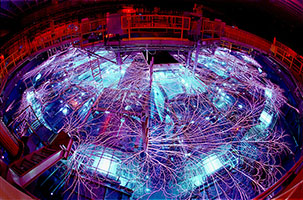
From Sandia National Laboratories Sandia National Laboratories is celebrating 25 years of research conducted at its Z Pulsed Power Facility — a gymnasium-sized accelerator commonly referred to as Z or the Z machine. Due to COVID-19 restrictions, only a limited number of former leaders of the pulsed power program at Sandia will gather Friday to…
Scientists create world’s thinnest magnet
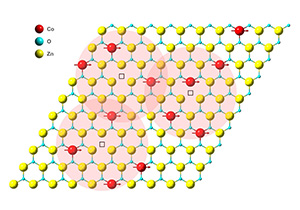
By Theresa Duque, Berkeley Lab The making of the world’s thinnest magnet: In this video, Berkeley Lab faculty scientist Jie Yao describes how he and his team achieved their record-breaking 2D magnet, the first one-atom-thin magnet that operates at room temperature. (Credit: Jenny Nuss and Marilyn Sargent/Berkeley Lab) The development of an ultrathin magnet that…
LaserNetUS High-Power Laser Consortium, including Berkeley Lab, receives $18M from the U.S. DOE
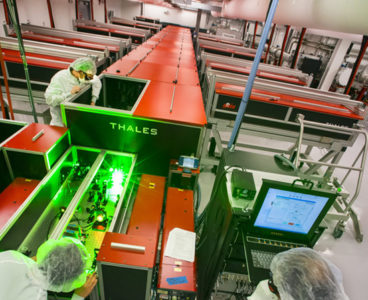
In 2018, the U.S. Department of Energy established LaserNetUS, a network of facilities operating ultrapowerful lasers. Organized and funded through DOE’s Office of Fusion Energy Sciences (FES), the new network was created to provide vastly improved access to unique lasers for researchers, and to help restore the U.S.’s once-dominant position in high-intensity laser research. Now,…
Quirky response to magnetism presents quantum physics mystery
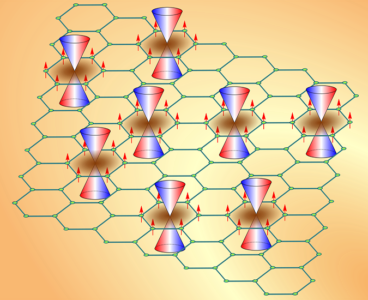
By Karen McNulty Walsh The search is on to discover new states of matter, and possibly new ways of encoding, manipulating and transporting information. One goal is to harness materials’ quantum properties for communications that go beyond what’s possible with conventional electronics. Topological insulators — materials that act mostly as insulators but carry electric current…
Three awards will support accelerator R&D for medical treatment, miniaturization and machine learning
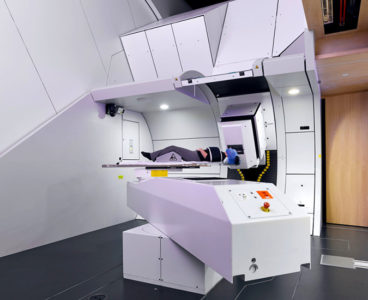
By Glenn Roberts Jr. U.S. Department of Energy awards announced in July will advance Lawrence Berkeley National Laboratory (Berkeley Lab) R&D to develop a more effective and compact particle-beam system for cancer treatment, improve particle-beam performance using artificial intelligence, and develop a high-power, rapid-fire laser system for both tabletop and large-scale applications. In total, the…
SwRI, UTSA researchers work to better understand hypersonic flight environments
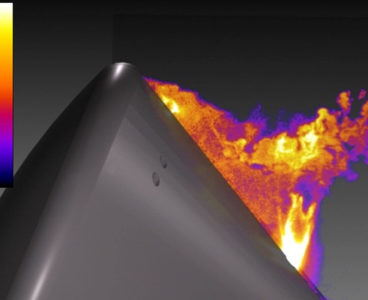
Researchers from Southwest Research Institute (SwRI) and The University of Texas at San Antonio (UTSA) are working to develop unobtrusive diagnostics for hypersonic flight testing. The project led by Dr. Nicholas J. Mueschke of SwRI’s Mechanical Engineering Division and Dr. Christopher Combs of UTSA’s College of Engineering is supported by a $125,000 grant from the…
Dance, electron, dance: Scientists use light to choreograph electronic motion in 2D materials
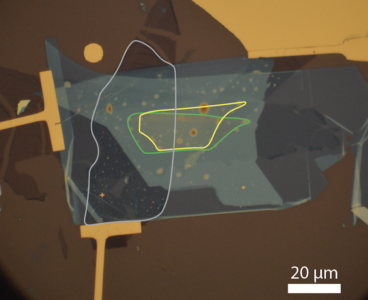
By Theresa Duque A team of scientists led by the Department of Energy’s Lawrence Berkeley National Laboratory (Berkeley Lab) and UC Berkeley has demonstrated a powerful new technique that uses light to measure how electrons move and interact within materials. With this technique, the researchers observed exotic states of matter in stacks of atomically thin…
Negative-stiffness vibration isolation aids research into portable atom interferometry at UC Berkeley’s Müller Group
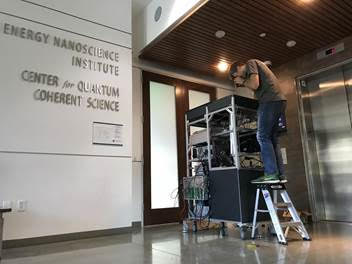
by Jim McMahon Professor Holger Müller’s Group at UC Berkeley is focused on advancing experimental quantum technology to push the sensitivity of experiments to new levels, and to perform precision measurements of fundamental constants. The group’s work uses methods from atomic, molecular and optical physics. One project is the development of a transportable, multi-axis atom…
Dancing electrons solve a longstanding puzzle in the oldest magnetic material
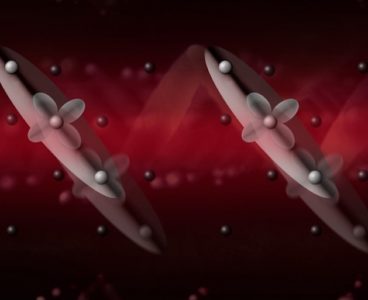
Magnetite is the oldest magnetic material known to humans, yet researchers are still mystified by certain aspects of its properties. For example, when the temperature is lowered below 125 K, magnetite changes from a metal to an insulator, its atoms shift to a new lattice structure, and its charges form a complicated ordered pattern. This…
Three national laboratories achieve record magnetic field for accelerator focusing magnet
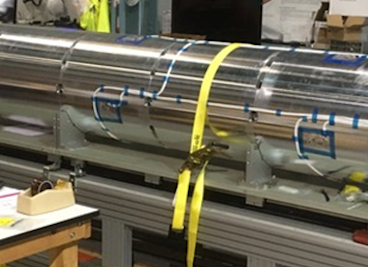
In a multiyear effort involving three national laboratories from across the United States, researchers have successfully built and tested a powerful new magnet based on an advanced superconducting material. The eight-ton device –- about as long as a semi-truck trailer — set a record for the highest field strength ever recorded for an accelerator focusing…
Universidad Politécnica de Madrid’s latest Magerit-3 supercomputer energizes and enables discovery in nuclear and material physics
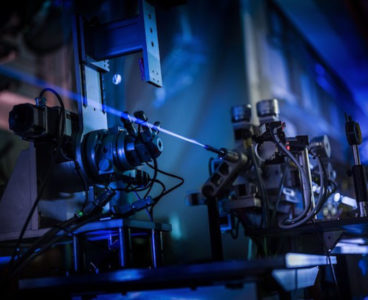
By Ken Strandberg The European X-ray Free-electron Laser (European XFEL), recently completed its first experiments that captured images of an antibiotic-disabling enzyme. Scientists use X-rays to bombard molecules and project molecular smatterings on a sensor that reconstructs what the target looks like. With these high-energy X-rays we now have 3D visualizations of actual molecules, like…
Closely spaced hydrogen atoms could facilitate superconductivity in ambient conditions
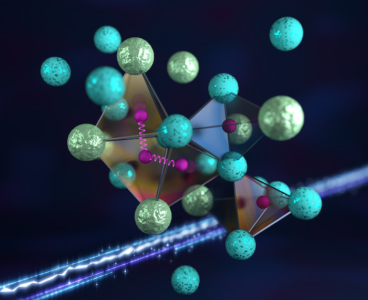
An international team of researchers has discovered the hydrogen atoms in a metal hydride material are much more tightly spaced than had been predicted for decades — a feature that could possibly facilitate superconductivity at or near room temperature and pressure. Such a superconducting material, carrying electricity without any energy loss due to resistance, would…
Department of Energy selects site for Electron-Ion Collider
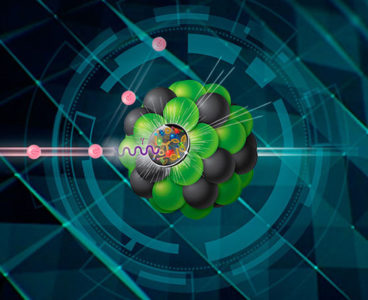
Yesterday, the U.S. Department of Energy (DOE) named Brookhaven National Laboratory, on Long Island, as the site for building an Electron-Ion Collider (EIC), a one-of-a-kind nuclear physics research facility. This announcement, following DOE’s approval of “mission need” (known as Critical Decision 0) on December 19, 2019, enables work to begin on R&D and the conceptual…
Mass Photometry: revolutionary biotech by Refeyn Ltd. wins prestigious awards

Refeyn Ltd., a spinout from the Department of Chemistry at the University of Oxford, has been recognized by two prestigious science and innovation awards for its revolutionary mass photometry technology. Refeyn’s first instrument, the Refeyn OneMP, enables users to measure the mass of single molecules in solution – quickly, simply and accurately. The company’s proprietary…
Two Brookhaven Lab Scientists Named Fellows of the American Physical Society

The American Physical Society (APS) has elected two scientists from the U.S. Department of Energy’s (DOE) Brookhaven National Laboratory as 2019 APS fellows. With more than 55,000 members from academia, government, and industry, APS seeks to advance and share physics knowledge through research journals, scientific meetings, and activities in education, outreach, and advocacy. Each year,…
Coherent poly propagation materials with 3-dimensional photonic control over visible light
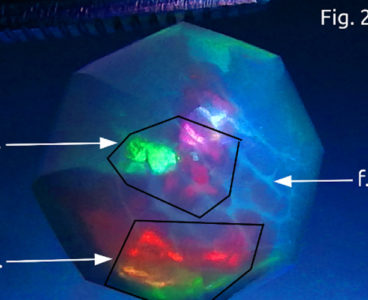
By: Dr. Michelle R. Stem Three-dimensional visible light photonic control is accomplished via the newly identified property of coherent poly propagation (CPP). This property is exhibited by a special silicate that is a rare form of a gemstone found in nature – opal. Dr. Michelle R. Stem discovered and examined several specimens of this material.…
Penn Engineers Design Nanostructured Diamond Metalens For Compact Quantum Technologies
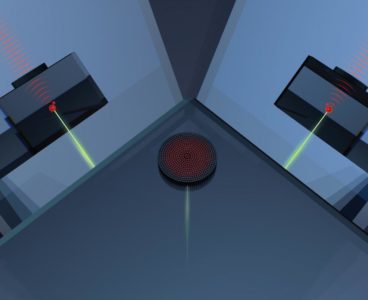
At the chemical level, diamonds are no more than carbon atoms aligned in a precise, three-dimensional (3D) crystal lattice. However, even a seemingly flawless diamond contains defects: spots in that lattice where a carbon atom is missing or has been replaced by something else. Some of these defects are highly desirable; they trap individual electrons…
Organic Electronics: a New Semiconductor in the Carbon-Nitride Family

Using Physics to Print Living Tissue
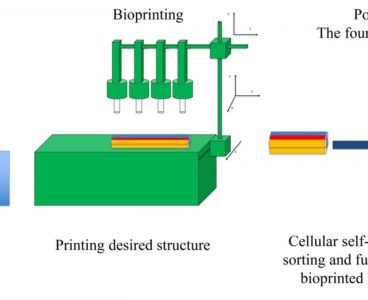
3D printers can be used to make a variety of useful objects by building up a shape, layer by layer. Scientists have used this same technique to “bioprint” living tissues, including muscle and bone. Bioprinting is a relatively new technology that has advanced mostly by trial and error. Scientists are now using the laws of…
Physicists ‘Teleport’ Logic Operation Between Separated Ions

Physicists at the National Institute of Standards and Technology (NIST) have teleported a computer circuit instruction known as a quantum logic operation between two separated ions (electrically charged atoms), showcasing how quantum computer programs could carry out tasks in future large-scale quantum networks. Quantum teleportation transfers data from one quantum system (such as an ion)…
A Light Matter: Understanding the Raman Dance of Solids
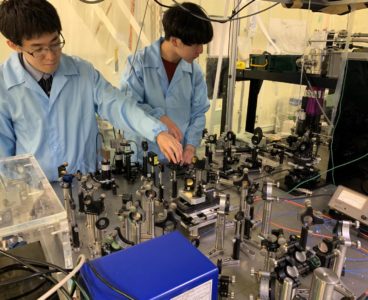
Scientists at Tokyo Institute of Technology and Keio University investigated the excitation and detection of photogenerated coherent phonons in polar semiconductor GaAs through an ultrafast dual pump-probe laser for quantum interferometry. Imagine a world where computers can store, move, and process information at exponential speeds using what we currently term as waste vibrations–heat and noise.…
Quantum Communication: Making Two From One
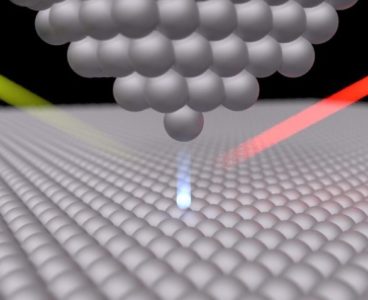
In the future, quantum physics could become the guarantor of secure information technology. To achieve this, individual particles of light—photons—are used for secure transmission of data. Findings by physicists from the Max Planck Institute for Solid State Research could play a key role. The researchers accidentally came across a light source that generates a photon…