
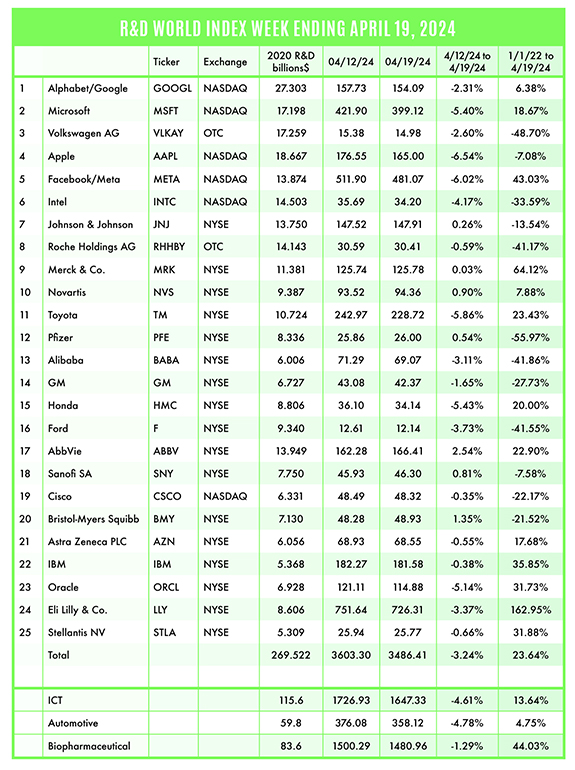
 The R&D World Index (RDWI) for the week ending April 19, 2024, closed at 3,486.41 for the 25 companies in the RDWI. The Index was down -3.24% (or -116.89 basis points).
Click to enlarge.
Seven RDWI members gained value last week from 0.03% (Merck & Co.) to 2.54% (AbbVie). Eighteen RDWI members lost value last week from -0.35% (Cisco) to -6.54% (Apple).
RDW Index member General Motors, Detroit, announced last week that it had opened its new design building in its Warren, Michigan, Technical Center. Combined with its old 225,000-ft2 design building, the company now has the largest automotive design facility in the world. The new design building is part of a $1 billion upgrade of the Technical Center campus. The new building, called Design West, is a low-slung counterpart to the existing design building. It wraps around a shining dome standing next to the older building. The new building’s many windows allow full-scale automotive mockups to be seen in natural light. The new building’s size allows several design groups space for collaborative designs.
RDW Index member Volkswagen Group, Wolfsburg, Germany, announced last week that it planned to invest $2.7 billion to expand its R&D operations in Hefei, China, to accelerate new product development in China’s marketplace. The company has already invested $1 billion in the existing Hefei center, its largest R&D operation outside Germany. The new investment will speed the development and production of two new VW smart battery electric vehicles (BEV) currently under development in collaboration with Chinese startup Xpeng. VW plans to launch 30 completely new smart BEVs in China by 2030.
Mercedes Benz, Stuttgart, Germany, announced last week that it has inaugurated a new $10 million building in Shanghai, China, upgrading its existing R&D center. The new building contains innovative spaces, testing labs, and workshops. The center enables efficient software and hardware development and comprehensive environmental simulations. The company’s R&D network in China is its most comprehensive outside of Germany.
Last week, Applied Materials, Santa Clara, California, announced that it may abandon or postpone its plans to build a $4 billion R&D facility in Silicon Valley due to a lack of government funding. The Biden administration said earlier that it would scrap plans to fund the Applied Materials program from the $52.7 billion Chips and Science Act due to “overwhelming demand” for funding awards to subsidize semiconductor chip production. The Chips bill was signed in August 2022 amid a global chip shortage, in a bid to bolster U.S. competitiveness with China in science and technology. Applied Materials announced its plan for the California research center in May 2023 to speed up advances in semiconductor manufacturing.
General Electric has sold off its famed 60-acre Crotonville, New York, management academy as part of its split into three companies. Opened in 1956, the facility is no longer suitable for the three individual companies. , Given its historical significance, the new owners look to set up meetings and conferences on the site.
RDW Index member Microsoft, Redmond, Washington, announced last week that it’s investing $1.5 billion in a technology company backed by the United Arab Emirates (UAE) in a deal that includes an intergovernmental pact to ensure AI security as the U.S. and China increasingly compete for influence in the Gulf Region. Abu Dhabi’s growing ties to China and its technology firms has strained U.S.-UAE relations for the past few years. This new agreement between Microsoft and Abu Dhabi-based G42 signals a pivot toward Washington, D.C., for the Gulf state. Terms of the deal were not disclosed. Microsoft president Brad Smith will join G42’s board and G42 will use Microsoft’s cloud services for its AI applications. The pact also creates a $1 billion fund for AI developers.
RDW Index member Apple, Cupertino, California, announced last week that it’s considering making some of its products in Indonesia. This follows its plan to ramp up its manufacturing investments in nearby Vietnam. Most of Apple’s manufacturing is performed in China, but the company is looking to diversify its supply chain amid rising U.S.-China tensions and global concerns about decoupling trade. In a separate announcement, Apple will invest more than $250 million to expand a regional hub in Singapore to support growth and new undertakings in AI as the company looks to diversify its footprint in Asia and reduce exposure to China. Apple will begin construction on the Singapore campus in late 2024, including upgrading two buildings acquired in 2022 that support its local workforce of more than 3,600 employees.
Taiwan Semiconductor Manufacturing Company (TSMC), Hsinchu, Taiwan, announced last week that the company expects more than 10% of its revenue in 2024 to consist of the AI-related chips that Nvidia, Santa Clara, California, uses. The company expects this volume to rise to more than 20% within four years. AI demand is strong and TSMC has done its best to ramp up capacity, but it’s still not enough, according to TSMC’s CEO. TSMC stock shares have risen 36% in 2024 due primarily to its AI business and despite lackluster demand in non-AI parts of the chip market.
R&D World’s R&D Index is a weekly stock market summary of the top international companies involved in R&D. The top 25 industrial R&D spenders in 2020 were selected based on the latest listings from Schonfeld & Associates’ June 2020 R&D Ratios & Budgets. These 25 companies include pharmaceutical (10 companies), automotive (6 companies), and ICT (9 companies) that invested a cumulative total of nearly 260 billion dollars in R&D in 2019, or approximately 10% of all the R&D spending in the world by government, industries, and academia combined, according to R&D World’s 2021 Global R&D Funding Forecast. The stock prices used in the R&D World Index are tabulated from NASDAQ, NYSE, and OTC common stock prices for the companies selected at the close of stock trading business on the Friday preceding the online publication of the R&D World Index.

Tell Us What You Think!